Thought, Sensation, Perception. The Mental Content Within You & I
Leave your preconceptions at the doorstep.

Contents of the mind makeup the story and also the theatrical complication of our consciousness. Through these contents, we form ideas about how we name and connote our surroundings or our circumstances. We live by and worship a constructed image of people, places, ideas, and situations through the power of identification.
It is understood these mental contents are plenty and color every waking and sleeping moment of our lives. One hears terribly often nowadays of overthinking, becoming sensory overloaded, or of developing deep-seated anxiety because of the crowded contents of daily living, that which reflect back the crowded contents of the mind.
Why is mental blockage and deterioration so commonplace? We must first look at the root of this entire condition, the very cause of mental conflict itself: Thought. Thought is the ordinance of ideas, beliefs, and the labeling of physical and psychological references, which follow a pattern based on past experience.
Thought is habitual, and the mind uses thought to bring about analysis at its clearest, and aimless chattering at its muddiest.
Thought is the root cause of technological, ideological, and civil innovation in our world.
Thought requires past, accumulated knowledge in order to shape the habits and beliefs the present day human uses to move within this civilized world.
However, it is understood all individuals to some degree think differently, even if social bias prompts individuals to conform in cultural-specific uniformity.
These fundamental differences in thought processes are a series of possible combinations and permutations of environmental, cultural, religious and biological factors, which produces a diverse result for each individual’s thoughts & communication.
Moreover, the passage of chronological time often also mutates a person’s thoughts and thereby their inner beliefs, depending on the developmental or otherwise degenerative experiences they undergo.
Notwithstanding the movement of thought, it is impossible to be without the psychological and biological sensations and impulses that color our humanity.
Why is mental conflict a daily burden?
Why does the mind come to understand something, but then utterly contradict itself afterwards in one’s verbal response or action?
What is thinking? What is meditation?
How can we truly think critically?
How can the space for real meditation come about in the mind? What stops the mind from being clear and free of intrusion?
Why are thoughts difficult to silence?
Why are beliefs so hard to let go of?
These are rhetorical questions to keep with you for as long as your body and mind are healthy.
If You are here reading up until now, you must be seeking a new perspective. Do not worry about whom or where this perspective is coming from, and do not fixate on yourself too much when reading this piece. If you find yourself present here, you must care to engage in critical thinking or raw observation. These two are fundamentally distinct mental states, which will be recapitulated in the consequential conclusion of this work.
Before we discuss these two mental states, let us continue by naming common mental factors permeating the mental state of a person, these heavier ones include:
Confusion
Fear
Shame
Doubt
Desire
Apathy
Anxiety
Psychological Pain & Pleasure
Psychological Addiction
Contradiction & Doublethink
Mental Obsession
Mental Compulsion
Black & white thinking
Projection
Regression
Displacement
Repression
Transference
Suppression
Blindspot Bias
Absorption of the Other’s thoughts & feelings
Self over/underemphasis
Other over/underemphasis
Attention scattering or splitting
Mental Rumination
Thought Crowding/Layering
Intellectualization of emotions & sensations
Doublespeak
Groupthink
Beliefs & Ideas
Psychological Time
This variation of mental content means that there are multiple factors for the mind to process in the 10-20 hours one (the able-bodied individual) is awake each and every rising day, with its accompanying night.
You will notice this list of contents combines differing schools of psychology as it has been developed in the Western world over the course of nearly 200 years. These words are merely conventional, but they refer to a process one can observe in oneself. It is effective to match each item with an instance you can recall you have either enacted such mental process/psychological impulse, or have been at the receiving end of such condition. Take each one seriously.
Allow the contents of the mind to be separate, not in psychological fragmentation like a psychiatric patient, but merely separated within the context of time & space, in effect, putting this content in its place as if cleaning your home. Have you ever heard people talk about the physical state of your home reflecting that of your mind?
The mind needs space. Sometimes when you find yourself having to multi-task, perhaps you are accomplishing a lot, but can you question how attentive you are, or are these multi-tasking skills based on the reliance on past knowledge through habit? Consequentially, your attentiveness is reduced to that lens of past knowledge, perhaps relying on speed and scattered thought, just to complete tasks.
There are moments where your attention is scattered and fragmented, one piece is attending to a task, say at work or home, and the other piece is ruminating on a past event that has impacted you, negatively or positively, and yet another piece is thinking of what to eat after you finish your task, or what you want to do at all.
Can you sit with the feeling of what these previous sentences induced, it feels hectic, yes? This is the crowded lifestyle we are encouraged to follow now. Multitasking is seen as optimizing productivity at work or home, and yet if we look externally, space is only achieved after you have rearranged furniture, and cleaned up the clutter, and when you can finally go to sleep to stop for the day.
You must dedicate one piece of time to a task to then move on to another once the first is finished. It seems obvious and even condescending if you take it personally, however, you’ll notice the mind benefits exponentially over time from the habit of creating internal space.
Why is space important? How can we find space inwardly and outwardly in the world we live in today?
In effect, thought & sensation/emotion could potentially create conflicts that bring about all sorts of disorder, disorganization, incoherence, contradiction, and dis-ease in the mind in response to the external world at large. This is especially true without the presence of space.
So could we ask, and question with active listening, why does the mind accumulate so much thought and content, and why is mental conflict so easy to come across? How can we put an end to the conflict of the mind? The answer is simplification through observation. Let us begin through preemption.
Before entering or beginning anything, there is a preemption, a mental acknowledgement that you are about to do or experience something, which implies a length of time in that movement. This creates order in your mind.
Why must you preempt yourself this way as previously stated?
Take one more look at the aforementioned list of mental contents.
This preemption is so that you can clearly ask, as an example, if you are possibly projecting when you enact judgment upon yourself, or upon someone else, or upon a topic you are taking part in.
Is this judgment a determination of an observable fact in your external field, or is this judgment merely a truth you observe within yourself yet refuse to admit, thereby attaching it to the object in the external other?
This example can preempt you to think critically as you ascertain the truth in reading an online news journal, in dialoguing with another person, or in isolated thought.
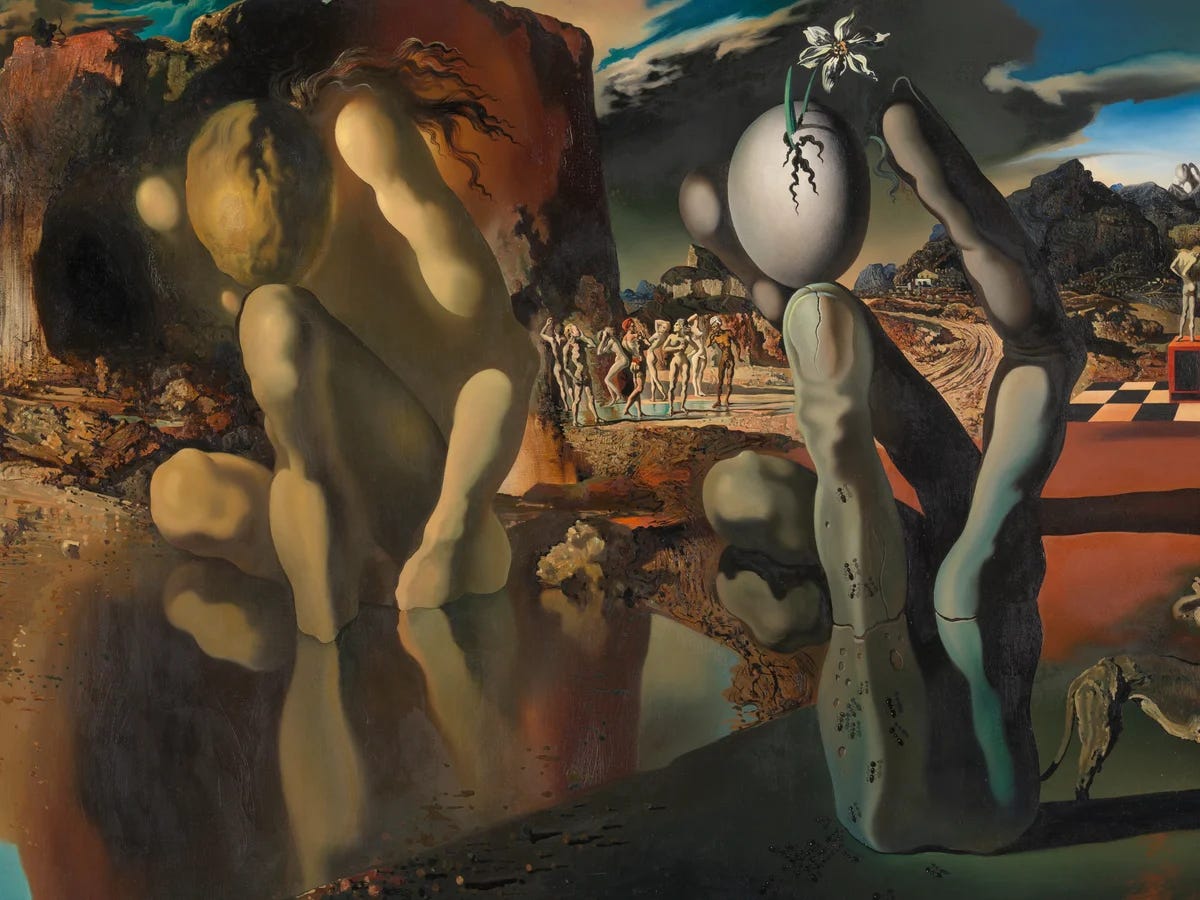
Metamorphosis of Narcissus (1937) by Salvador Dalí
So let us return to this simplification, you may preempt yourself by asking, are any of the aforementioned contents listed robbing me of a moment of mental clarity?
A lot of these pure moments we are robbed of can come about by identification. We feel the hurt in having our identification affirmed or challenged by the cruel perception of another. We can also rob ourselves of this pure moment by choosing to solely think of ourselves when we come to learn about a subject matter or receive insight about our life.
This forgetfulness and contradiction is the presence of an identified self in direct combat with What Is. This conflict causes gaps and dips in time, taking the individual in and out of truth through identification with the image or the word.
Identification comes with terms such as ‘’preference’’ or ‘’aversion’’ or ‘’ugliness’’. There is a polarizing quality to choose or to react or to judge that obfuscates the process of perception.
One often makes these remarks with a continuous ‘’me’’ involved in the thought process, the center of one’s own world apparently.
This self-praise or self-fixation causes one to go out into the external, parading in one’s own self-importance, failing to give care to the entire perspective and field this truth may apply to at large.
This contradiction between the pure moment and identification, which is brought about through lack of care and forgetfulness, can be reflected outward, manifested in the self-centered behavior of modern living. The other is relegated as a mere extension of the self, fragmented and yet contradictory.
The observation of this dance between the ‘I’ and the pure insight, is in itself meditation. When you can observe yourself in the mental process of identification, while also, without choice, remaining in the presence of your own life in this very moment, you are automatically in meditation.
The observation of this dance between the ‘I’ and the pure insight, is in itself meditation. When you can observe yourself in the mental process of identification, while also, without choice, remaining in the presence of your own life in this very moment, you are automatically in meditation.
Meditation cannot be chosen, meditation is not with one foot in, one foot out. There is no analyzing, while also getting to observe or see. One either thinks or one meditates, that is it. One either analyzes or one is observant, that is all. This is why the space and the simplification of the mind is crucial to allow meditation to take place, it is awareness of all without choice, or with wires crossed in strenuous thinking.
There is no thought process in meditation, only the watching of everything that goes on inwardly and outwardly, without the expectation of the logical or the calculated. There is a release of acceptance and intolerance, of control and presumption, leaving behind a mind that is at liberty to observe with no more content.
So if you return to thinking, would you not believe it is necessary to identify in order to predicate the problems among other subjects, as a necessary meat or fuel of thought?
The simple answer before you ignite yourself into critical thought: One needs knowledge, one needs problem solving skills, but one does not need to attach oneself to theories.
One needs to sharpen one’s skills by allowing oneself to start over or admit faults and limits.
Things must end in order to truly function again. Repetitive technique can work temporarily, but rigidity breeds neurosis. Change should be the inevitable variable here.
The one with scientific thinking must be willing to venture into the unknown, not attached to hypotheses nor the past in order to problem solve. Suggestions are not always reality.
(We can discuss the ethics, disproportionate deprivation of, and advocacy politics of education within and beyond traditional schooling, but that can be saved for a separate piece.)

Seated Giant (1818) by Francisco Goya
Does one ever question how our 21st century mind came to be? How can we handle such complexity, navigating material skill knowledge, habits, creative ideas, identity, etc?
So, let us examine the mind and how humans have used their mind in common over time. The mind is humanity’s prime tool in distinguishing themselves as people of both will and depth. In the world we have built however, the mind finds itself crowded and overly-programmed to function orderly in this world of information and innovation.
Over the millions of years that the human animal has used its mind, the development of ceremonial, hunting, building & cooking tools, elaborate houses, animal domestication, clothes, and artworks all signified the advent of a time in which the human had developed a more sophisticated mind than ever before.
The cultural practices of oral history, ritual, memory, and the arts, have allowed the mind to organize itself over the course of hundreds of thousands of years.
Take the mind as a technological organ, biologically wired to inherit past knowledge, fears, and other personality traits from past family members up the genealogical tree. The mind is hardwired to fear phenomena such as the dark, natural disaster, wild animals, death, abandonment, among other things.
At times, do you ever question if the habits, beliefs, and reactions you have are yours, or do they belong to someone else, living or defunct? Or at a larger scale, do these beliefs and habits stem from a relationship to society, molded by obedience and uniformity?
Let us examine in nature, The Foal. The Foal, as a representative of many animals and their behavior, is instinctually hardwired to know exactly what to do and executes its purpose from the moment it is born. The mare, its mother, is a towering creature in comparison to the small foal. The amniotic sac the foal once was encased in must burst open, taking a fall from its mothers womb, perhaps falling 4-6 feet depending on its mother’s stature. The foal, in an alarming instant, is exposed to the reality of the air, the ground, and finally, the sensation of pain.
This foal has been gestating in the mare’s womb for nearly one calendar year, its body and legs folded up into a stasis, barely moving in its sac.
Yet somehow, perhaps miraculously, in a short while, the foal is able to unfold its limbs, orient itself straight like its mother, perhaps as its mother coaxes it upright, and the foal learns to walk and run within just a few short hours.
Why is this example from the animal kingdom brought up? This is because this blood memory is a genetic encoding passed down from parent to child, in order to ensure survival. Observe the parallel between the animal and human mind using this example. A healthy foal, in our case, must be able to walk and run under a short amount of time, just as its mother, father, and grandparents did, to escape premature death or illness.
This foal must quickly develop the habit of sleeping standing up just like its mother, unlike the fetal position it was used to staying in within the womb for such a long time. The fear of death and sickness has prompted humanity to use the mind as an instrument to construct reality, seeking refuge from strife and even disaster. This mental custom has been developed over thousands or perhaps millions of years, to rely on the human mind for survival and relationship.

Mare with Foals (1912) by Franz Marc
The human brain and nervous system are trained to behave in synchronistic uniformity throughout all phases of life. Although babies are born dependent, solely on their caretakers to provide and care for them, they quickly absorb and exhibit habits of living and deceased family members through speech patterns, domestic habits, social habits, and so on and so forth.
Visualize this ancestral phenomenon as a spiritual Pavlov technique.
You are Pavlov’d to associate this stimuli with this idea: the dark, which one associates with danger and the unknown, caused by the sun, which allowed us our sight, has set.
What is the one phenomenon to end the rigidity in beliefs and ideas of an individual?
Why, death, of course.
The thoughtform is passed on. The habits are passed on. But death ends all. Death takes with it all mental processes, as the individual is effectively dead.
However, could one end the patterns, beliefs, and thoughtforms one carries before one passes away?
Why await death to let go of what you believe as known, and fixed, when nothing in this life is completely known or fixed?
If we can end what we believe and think we know, we can see with clearcut perception, untouched by influence.
Before closing this section, if you are interested in a more overtly political example of thoughtforms, let us discuss the rivaling thoughtforms of collectivism versus individualism.
Countries and their attitudes towards the family structure, community structure, and socioeconomic structure (outside of the nuclear familial, merchant class economic Anglo-Saxon, Western European, Latin American, and Ethiopian worlds) are downstream from the religious doctrine and political history that precede them, most likely dating back at least 100 to more than 2,000 years. These intergenerational attitudes of protestant/orthodox Christian descendant financial and familial sovereignty, or the communitarian economic family practices of modern Russia and China, are practices which reflect old thoughtforms, downstream from a political-religious precedent.
Collectivism and Individualism originally thought of as being a global southern and western custom (respectively), this moment we find ourselves in begs the re-examination of the politics between different age demographics (or other demographics) even within a western country, or outside.
Social media and modern lifestyle choices have begun to globalize the landscape of (often younger) groups within countries traditionally seen as collectivist in tradition.
Japan and United States’ homeless population is not only on an upward trajectory, the ones affected are behaving radically outside of traditional respective customs regarding living. Living frugally, in either hotel rooms or out of their vehicles, is what is seen as a kind of hidden homelessness reflected in this current economy. These individuals most likely lived a normative domestic life prior to their precarious situation, and have had to scrappily adapt. The social isolation, and/or subsequent reliance on fellow homeless friends and acquaintances, have surely radically transformed the beliefs and outlook of people living in an individualist nation like the U.S., or a collectivist nation such as Japan.
To recap, the mind is clearly a cultural product for the average human, but even time and circumstance can radically change or at least heavily clash with one’s beliefs and thoughtforms.
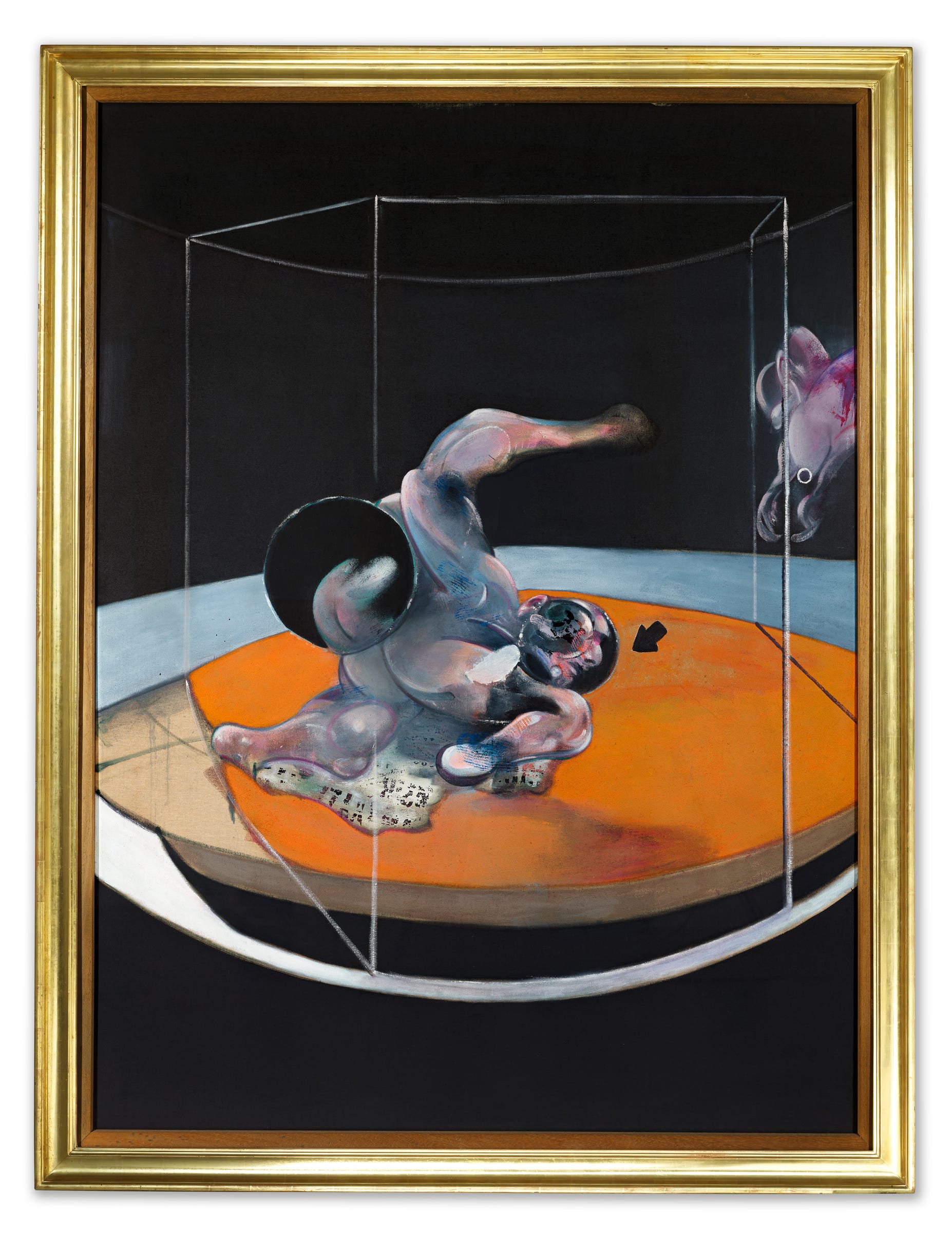
Figure in Movement (1976) by Francis Bacon
On a more exploratory and technical note, there is something curious to note about the organs involved in all these processes.
The eyes, brain, spinal cord, ganglia, and finally the nerves all make up the central and peripheral nervous system. These are the central units in processing all sensory, memory, cognitive, and motor functions that entail consciousness itself.
This topic regarding the limbic and nervous systems speak about the moving parts necessary in the processing of information, or stimuli in our external and internal living. Neurons and stem cells are one of the most difficult cell structures to undergo cell turnover during cellular respiration. Could this be because of the amount of energy expended using these structures for the rest of the body?
Can this scientific fact key us in to the inherent division of body and mind?

The Skull Sectioned (1489) by Leonardo da Vinci
As a takeaway for reading until the end, I would like to sum up:
It is absolutely necessary to be able to clearly and simply distinguish what one is feeling, thinking, believing, or perceiving. Thus, it is crucial to understand when to think, and think deeply, and when to merely observe, without choice.
In a world that is growing increasingly loud, sensorially dense, data dense, and above all, increasingly automated, the mind is at risk of rigidity and deterioration.
Why should one think critically?
In order to clearly identify the root cause of problems and confusion. This way, to identify its logical endpoint from interacting with and parsing through the density of information, alongside the different forms of organized (socioculturally distinct) thinking, (that can convolute the individual’s perception of media, demographics, social sectors, phenomena, and nature.)
In order to question with development and sharpened structure over time.
In order to refine one’s mind and life to be of a higher quality.
In order to learn to ask a question carefully, with intention.
In order to develop skill and technique in any area of living.
In order to put the mind in coherence & laser-focus.
Why should one meditate?
To relieve the mind-body-spirit complex of left-brained activity.
To simply observe the nature of creation and of human civilization, in one’s surroundings.
To recognize the reality one inhabits without a center or point of hierarchy
To observe without any form of identification.
To accept the problems, confusions, conflicts, and convolution within oneself and within the world as interconnected and, although distinct, not isolated.
To allow one’s mental contents to be eventually empty and ultimately fragmented, as is being human.
The mind is both complex and simple, and is constantly in response to the process of external and internal stimuli, there must be both an order and a consequent release from the density of the modern world’s noise and content.
Whether one is 16 or 53, understanding the axial relationship between the external and internal is going to always be crucial as long as one lives. The contents of the mind that were mentioned are but a starting point to understanding the facts of solitary and relational human mental behavior, this way, you are beginning to more deeply interact with the book of life.
Is it not an art, to live in the humility of understanding the human, made up of the atoms and elements that make up stars, yet is fragmented to dance between understanding and confusion, all while reckoning this truth?
Until next time.
Beauxrealis ☉ ✵ ☽
As a general note, it is advised to keep this text in perspective, as one should all texts, as you will not receive insight by immediately agreeing, disagreeing, reacting, or assuming because of what you have read.
This is especially true if you spend time reading a long body of text, whether this be from a lone writer, or an entire media outlet. The motives of this body of work are to distinguish different states of the mind, and to address the responsibility of the individual to question any and everything they come across, and lastly to undo unnecessary programming of the mind.
This topic is not new, nor is it accredited to the writer, this work is a byproduct of both past learning, and timeless contemplation, pen to paper, digit to screen. This is not meant to be analyzed, nor is it meant to be categorized as merely philosophy or psychology. It is also important to note the writer is not a licensed psychologist, nor a neurologist. This is to invite the reader to question their own perception and thought patterns.
Research is encouraged, as is healthy skepticism.
It is best to take this text as a discussion with yourself, as there is quite a bit of density to break apart into parts.